Early July marks a critical stage in soybean production across the Midwest and northern growing regions: beginning bloom (R1). As plants enter the flowering stage, monitoring fields with high moisture and dense canopies can help farmers make timely management decisions before white mold takes hold.
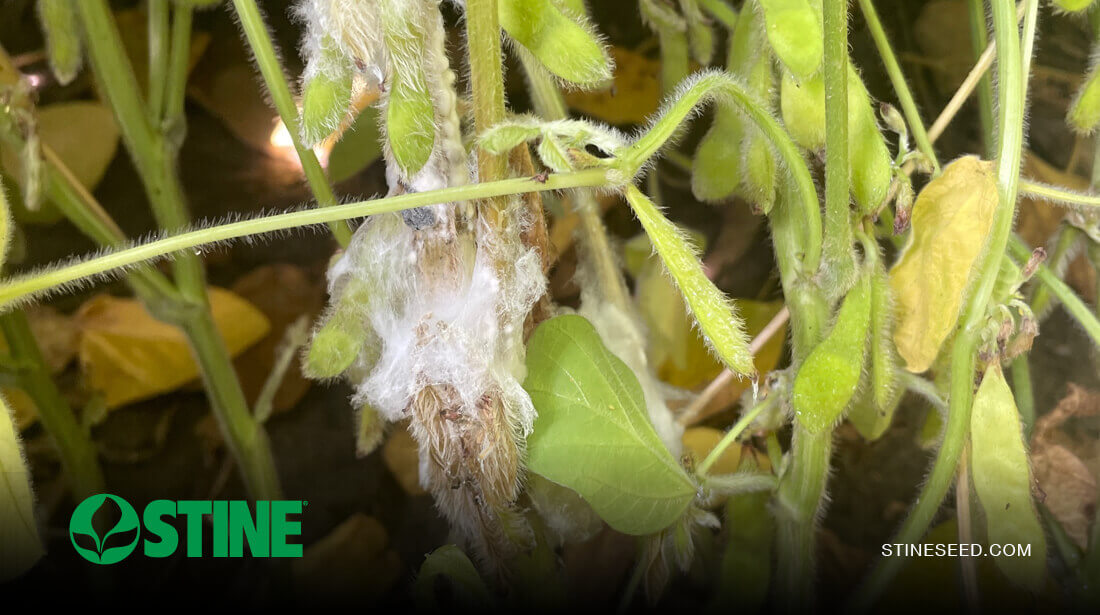
“Each year, white mold causes millions of bushels of damage for soybean growers, and with the cool, wet conditions many areas are seeing, the risk is high,” says Tyler DuBay, soybean technical agronomist for Stine® Seed Company. “An in-field fungicide application can still help growers slow down the infection before it spreads, but it takes careful timing.”
As fields near bloom and early pod fill, growers should assess their risk and implement a management approach before the window for effective action closes.
Understanding white mold
Before devising a strategy to suppress white mold infections, it’s important to understand how the disease develops.
White mold is a fungal disease caused by Sclerotinia sclerotiorum. The fungus overwinters in soil as sclerotia. Under cool, moist conditions, it can germinate to produce apothecia, which look like small tan- to cream-colored, mushroom-like structures that release spores. These spores can land on open blooms during the R1–R3 crop production stages, often colonizing senescing blooms and infecting the plant. A persistently wet, humid canopy can prolong the flowering period and increase disease spread. While infection typically occurs during R1–R3, visible symptoms may not occur until R3–R6.
“White mold is fairly easy to spot once it develops, appearing as fluffy white mold on the stems and nodes of the plant,” notes DuBay. “Unfortunately, by the time you see it, it’s usually too late to do anything about it this season. This is why early July is a critical window to monitor your risk and map out a fungicide strategy.”
Knowing your risk
The best way to gauge your white mold risk is to combine what you know about your fields, including disease history and likely hot spots, with the Crop Protection Network’s Crop Risk Assessment Tool, which uses weather-based forecasting to estimate disease risk.
“If a grower has fields with a history of white mold or a known previous crop that can promote the disease, such as edible beans, a preventative fungicide pass may be worth the investment. The Crop Risk Assessment Tool can also show growers their infection risk specific to each field’s location.”
Tyler DuBay, Stine soybean technical agronomist
When in doubt, a timely fungicide pass may be a worthwhile consideration. If cost is a concern, the Crop Protection Network also offers a Fungicide ROI Calculator that can help farmers evaluate the potential economic benefits of fungicides for soybean white mold.
Fungicide timing for suppression (not elimination)
Fungicides between R1–R3 have proven effective for suppressing the disease, but timing is critical.
“In a high-risk field, a pass at R1 followed by another at R3 can be effective at reducing infection,” notes DuBay. “But once early pod set hits — after R3 — it’s too late for a foliar application. At this point, it’s time to start documenting and planning for what you can do at harvest or into next year.”
While fungicides can help protect fields from infection, it’s important to remember they cannot fully eradicate the disease. That’s why an integrated approach is necessary.
Integrated management options
Outside of fungicides, some growers have used a strong, well-timed herbicide application to open the upper canopy for increased airflow between the rows. Looking beyond this season, variety selection, seed treatments, crop rotation, residue management and a thoughtful planting strategy will be essential.
At harvest, be sure to thoroughly clean equipment between fields, as combines can trap soil and residue-carrying sclerotia and spread them to clean fields. It’s also a best practice to harvest white mold-infected fields last. Managing residue after harvest can help bury or degrade sclerotia, but both practices have pros and cons.
Next year, a comprehensive approach will be important, starting with crop rotation.
“Sclerotia can survive in the soil of infected fields for several years, so rotating to a nonsusceptible crop, such as corn or small grains, for two to three years can help reduce the disease,” notes DuBay.
Next comes variety selection and other management strategies. Stine has several outstanding soybean lines available for the 2027 season that offer strong white mold tolerance. When paired with an effective seed enhancement from our lineup of Stine XP® seed treatments, farmers can get added protection from white mold in future years.
Additionally, a solid planting strategy that includes lowering seed density, planting in wider rows and delaying planting to reduce canopy humidity during the critical infection window can help suppress the disease.
“There’s no one solution to eradicate white mold, so we need to integrate a multipronged approach to be proactive rather than reactive,” stresses DuBay. “One thing I tell growers is that if white mold has been an issue in a field for more than one year, crop rotation to a nonsusceptible crop will be a vital next step. Then adjusting your planting strategy will be an effective tool going forward on your infected fields. Sclerotia can live in your soil for many years, so ensuring airflow should be a top priority while still obtaining an effective canopy is essential.”
Product Development Plot research
As white mold continues to impact fields across the country, Stine is also evaluating how its products perform against the disease.
“As part of our Product Development Plot research, we’re conducting single-row disease studies to validate product tolerance to white mold,” says DuBay. “We’ve expanded our one-row research plots into four different locations, including Michigan, Wisconsin, northern Minnesota and northern Iowa, to generate more data on how well our products stand up to the disease. We also have internal and external collaborations to test additional varieties coming through the pipeline on the research side.”
This year alone, we’re testing 47 soybean varieties for white mold tolerance. The more information we can share with growers, the better their chances of finding a product that performs well in their specific environment.
To learn more about Stine’s products and research on genetic tolerance to this fungal disease, contact your local Stine sales representative.