With 88% of this year’s corn harvest complete, results are rolling in from growers’ fields and our test plots throughout the country. From Product Development Plots (PDPs) to strip trials to our Elite Yield Trials, Stine® Seed Company agronomists and sales representatives are already crunching the numbers and reviewing performance data to determine which products are the best fit for specific environments heading into 2027.
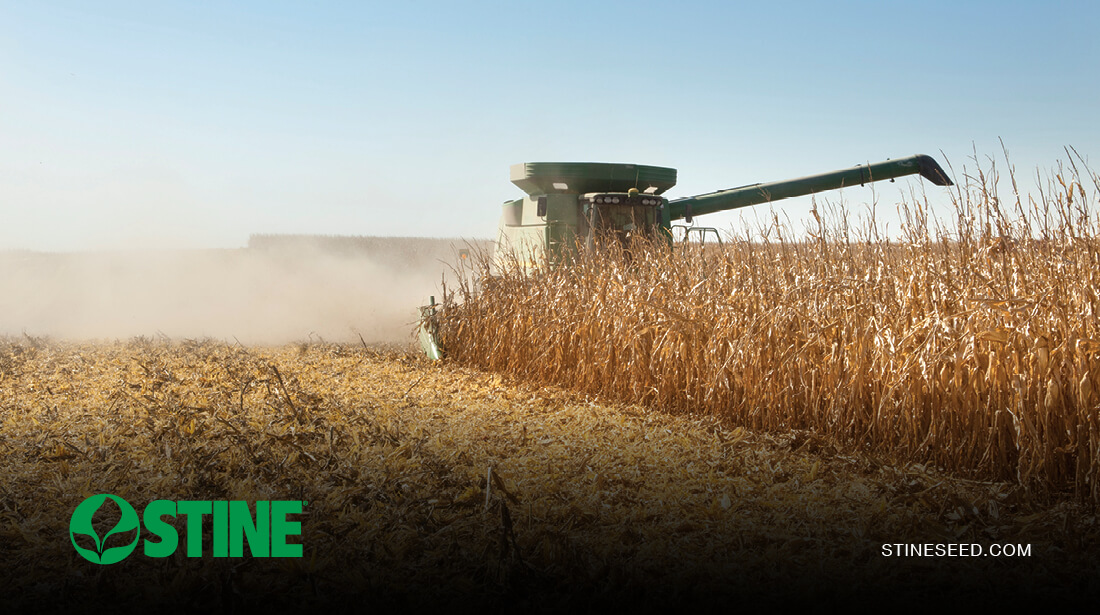
“If I had to describe the 2026 corn growing season in a few words, it would be variable and surprising with a lot of extremes,” says Brian Hartman, national corn product manager for Stine. “As in any year, the weather and disease pressure had different plans for us, but Stine products stood up to the test in many regions.”
Much of the success of Stine corn products comes down to genetics and product placement.
“The strength and size of our breeding program allow us to see not only how a product performs but also the conditions where it thrives or struggles,” says Hartman. “Not every product is a home run, so we really lean into what the data tells us. That way, when it’s time to talk to growers about next year’s products, we have the right guidance and data-backed performance metrics to help determine what will work best on their acres.”
2026 takeaways and what they reveal
Weather was all over the place.
The Upper Midwest went from a dry summer to a wet fall that delayed harvest and contributed to some late-season diseases and standability concerns. Late planting and poorly timed rains were an issue in areas of Indiana, Michigan and Ohio, which also delayed harvest. The South finished early and strong with timely rains, while the Northeast saw drought in some areas and excess moisture in others.
“Areas where I expected drought received excess moisture, and areas that usually have ample moisture turned excessively dry,” says Hartman. “Parts of the South that typically struggle with heat had remarkable yields, while parts of the North suffered from drought and heat. Calling this year’s weather unpredictable would be an understatement.”
What does this reveal?
No two seasons are alike, which is why it’s important to review multiyear, multilocation data when determining which products to plant next year.
“I remind farmers that no two years are alike, so they should never rely on data from a single year or a single location,” says Hartman. “At Stine, we utilize multiyear, multilocation research to score how consistently a hybrid performs across different environments.”
For growers, a well-mapped-out field history can show which products performed well in wet years and which did better in drier ones. While we can’t predict next year’s weather, we can draw on data from our plot program and past field history to determine whether to switch maturities, spread risk across different maturities or stick with what worked last year.
In 2026, Hartman notes that Stine MX481-G and MX471-G were consistent again with the variable weather conditions in their maturity zone, and 9754-20 and 9721-30 continued to shine. He also notes that products dried down well.
“Everything dried down really well this year, so I would say fuller-season hybrids performed better than earlier hybrids.”
Stalk quality was a late-season concern.
Late moisture and heavy disease pressure left some growers worried about standability heading into harvest. This was especially true in parts of Nebraska, Iowa, South Dakota and Kansas, where stalk rots showed up. Fortunately, many Stine hybrids held up well, which made for a smoother harvest and higher yields.
What does this reveal?
When you breed for yield, you also breed for stronger plants that can handle stress and build stalk strength from the ground up. Every hybrid in Stine’s lineup is thoroughly tested against the elements. In fact, of the tens of thousands of new hybrids we test each year, only the top 5% advance to our product lineup, so only the top-performing, highest-yielding corn reaches growers.
“Stine genetics continue to shine with standability, and this is a direct correlation with our testing program,” says Hartman. “We push populations to determine standability. We lead the industry in this area.”
Our MX Series Corn portfolio was a testament to this strength this year. Lines such as Stine MX471-G and MX481-G were consistent performers that delivered strong results in areas where standability was a concern. Others in our lineup that delivered similar performance in these areas included Stine 9690-30 and 9891-20.
Late-season plant health made the difference.
Added stress late in the season made other problems worse, including disease pressure, stalk rots and standability. Products that paired good genetics with a solid trait package helped keep plants healthy from planting through harvest.
What does this reveal?
Late-season plant health doesn’t just appear before harvest. It starts at planting, with proven genetics and strong seedling vigor. From the time that seed is planted until harvest, the right genetics and trait package help support plant health all season long. Once again, Stine’s MX Series Corn lineup stood strong throughout and handled mid- and late-season stress well. Stine MX261-G, MX321-10, MX481-G and MX521-G were great examples this year.
Disease and insect pressure are worth watching.
If you had noticeable insect or disease pressure this year, don’t overlook it in 2027.
Rootworms were a major problem this year and pose a silent threat to standability and yield. By feeding on corn roots, they disrupt water and nutrient uptake and weaken the root system. Left unmanaged, they can stunt growth, increase the risk of late-season lodging and reduce yield. In some areas, rootworm populations have also developed resistance to key Bt traits once used to control them, so growers need to stay vigilant.
Tar spot was also a concern this season.
“Tar spot really impacted a lot of areas this year,” says Hartman. “Fortunately, we were able to work with growers in the Yield Maximizer Program to notify them early about infected areas and help them prioritize which fields to harvest first.”
What does this reveal?
Rootworm isn’t going away, and it’s an increasing concern on corn-on-corn acres. Growers who had rootworm pressure in 2026 should prepare for it again in 2027 by working with their seed rep to find the hybrids and trait packages that can help manage it. For fields with low to moderate rootworm pressure, Stine XP SureFlow with TS201 is another option.
The same goes for tar spot. Stine has multiyear, multilocation data to help guide seed decisions on acres with a history of tar spot.
Hartman notes that heavy insect pressure this year also gave diseases more opportunities to take hold.
“Any insect feeding can create an infection site where disease can enter the plant,” says Hartman. “That’s why traited hybrids are often the right choice to prevent some of these issues.”
At Stine, we continue to evaluate trait performance and rotation strategies across our PDPs and customers’ fields, giving us timely insight into which hybrids stand up best to pests and diseases. While there’s no all-in-one solution, Stine agronomists can provide boots-on-the-ground support through our Yield Maximizer Program, including hybrid placement and crop rotation recommendations as well as trait strategy adjustments to help manage these issues going forward.
Stine corn delivered on our STINE HAS YIELD promise.
Thanks to strong genetics, innovative traits and fine-tuned product placement, several hybrids stood out across multiple regions in 2026.
What does this reveal?
Across the lineup, Stine genetics stand up to the elements, and our conventional hybrids are a solid place to start.
“In fields without insect pressure, conventional lines will continue to be the highest yielding hybrids,” says Hartman. “If you’re able to manage insects, conventional is financially the way to go. For producers with more acres spread out, traits are a great tool to use.”
On the traited side, Hartman was impressed by the performance of Stine MX481-G and 9532-30 in 2026.
“Stine MX481-G continues to be consistent,” says Hartman. “Over the last five years of data, it keeps rising to the top. And Stine 9532-30 is a strong contender in the 103-day relative maturity range for growers who want a hybrid with insect protection. Among our full-season hybrids, it’s hard to pick just one because they’re all performing well.
“Overall, we have a strong lineup from 80- to 119-day relative maturity, with hybrids for every situation. Our Yield Maximizer Program has allowed our sales reps to work with our agronomy team to get the right products placed on the right acres.”
Our plot data showed us what works where.
Stine had one of its most expansive plot programs yet this year, from PDPs to Elite Yield Trials.
“The biggest surprise from our corn plot program this year was that drought-stressed areas, where we typically have lower expectations, had shockingly good yields considering the year we had,” says Hartman.
What does this reveal?
As encouraging as those results are, it’s still only one year of data. That’s why our team continues to rely on multiyear, multilocation results. This also showed which management practices bring out the best of each hybrid.
“When management is done properly and we have dialed in planting populations and fertility, our hybrids perform best in their intended environments,” says Hartman. “Some of our hybrids prefer narrow rows and higher populations, and some don’t excel in those situations. Our intensive testing program helps identify those hybrids and how to maximize their yield potential.”
Shorter-stature hybrids continue to shine.
Standability remained a strength of our shorter hybrids in 2026.
“Our shorter-stature hybrids continue to stand out against the competition,” says Hartman. “Year in and year out, some field somewhere is going to have a wind event, and our shorter-stature hybrids are able to stand up against the environmental conditions.”
What does this reveal?
Weather is unpredictable, but standability is something you can count on when it comes to Stine short-stature corn hybrids. Working with your Stine rep to find a hybrid built to stay standing will help protect yield when extreme weather hits.
Looking ahead
As growers plan for the upcoming year, Hartman’s best advice is not to get caught up in the results of one year.
“No two years are the same. Use this year as an opportunity to try new things such as Stine XP seed treatments. For corn, growers can choose from Stine XP SureFlow + TS201 (Corn). Across 29 trials this year, we saw more than a 5-bushel advantage across several different maturities” says Hartman. “There are a lot of advancements in seed treatments that have proven themselves, and we look forward to bringing them to growers’ fields in 2027.”
As farming becomes more challenging, remember that the Stine team is available to be your business partner.
“Stine’s main priority is to maximize farmers’ profitability,” says Hartman. “Our founder, Harry Stine, is a farmer first, and he truly cares about our customers and wants them to be successful. That’s why we have programs like the Yield Maximizer Program, which we’ve had great success with and see the added value Stine is able to offer growers, making them more successful as well.”
Whatever the season Mother Nature delivers, there’s a Stine product that fits your acres. If you’re not sure which one, we’ll sit down with you, review your field history, compare it with our yield data and find the best solution together. Connect with your local Stine representative today to start the conversation.